
Case Study: Photovoice as a Pedagogical Approach

Photovoice is a hands-on process in which people take photographs to represent their experiences of or perspectives about a topic, challenge or opportunity. It is often used as a participatory approach in community-based research. PSHLP has used Photovoice to support learning and teaching.
Using photographs to communicate an idea or tell a story
- reflection and critical thinking
- engagement in learning and discussions
- identifying and taking actions
- opportunities to ‘have a voice’
- knowledge and skill development
- feeling empowered to take action
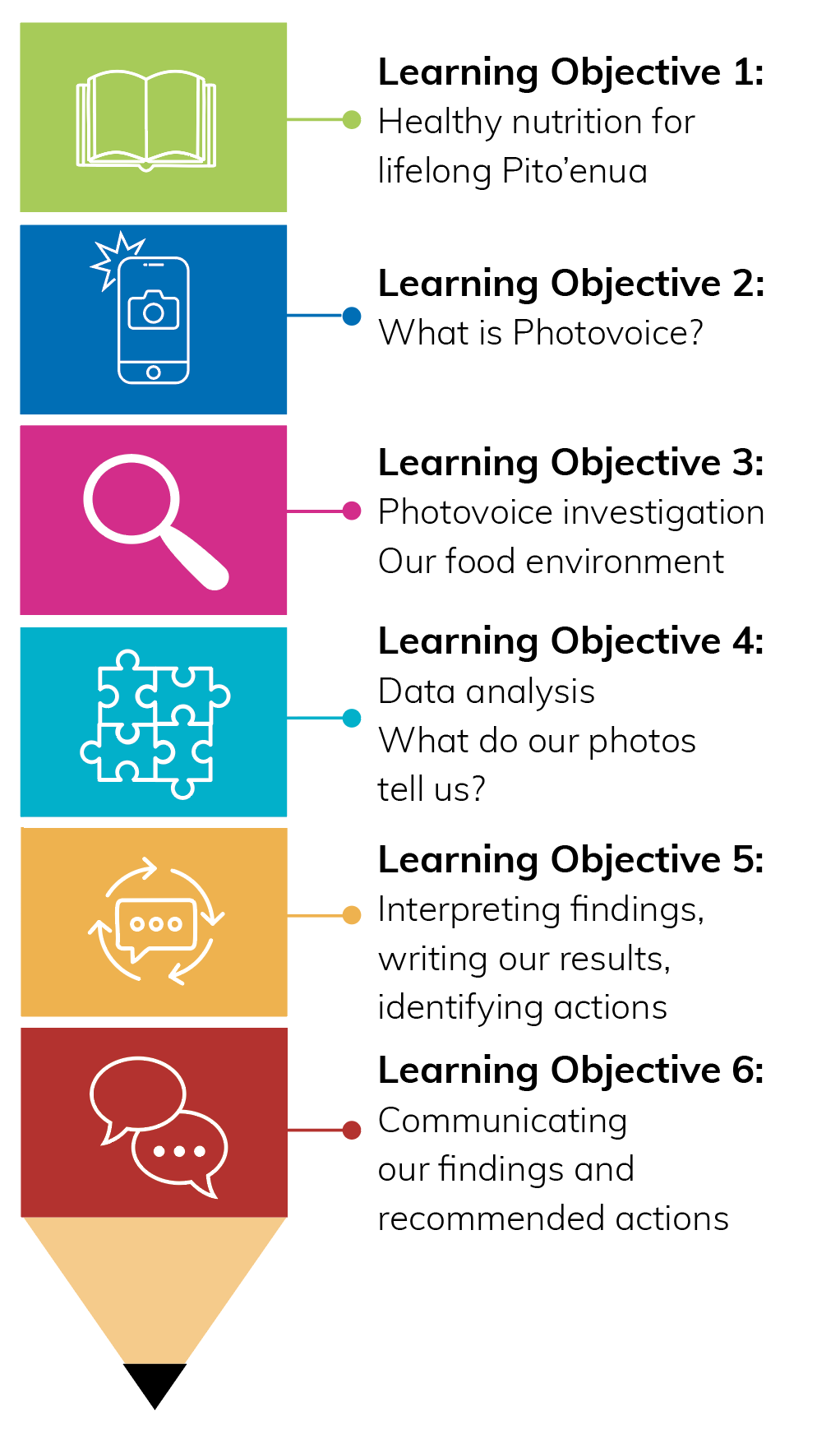
Project timeline
 |
|
 |
|
 |
|
 |
|
 |
|
 |
|
 |
|
Impact highlights
Locally-driven development
- Locally-determined goals and strategies encourage ownership and promote sustainability of developments.
- Teachers worked collaboratively to experiment with evidence-based approaches and refine these to suit their contexts.
- Knowledge of and concerns about the impacts of non-communicable diseases in Cook Islands communities motivated teachers to develop learning modules exploring food and physical activity environments.
In the Cook Islands, just about every child will have someone in their home who is suffering from an NCD.
Developing leadership among teachers
- Teachers leading monitoring and evaluation amongst their peers promoted constructive critique and development of locally relevant evidence.
- Teachers presented their findings at the Pacific Medical Association and Pacific Islands University Research Network Conferences in 2023. These opportunities promoted leadership skills and demonstrated to teachers that their work was valued locally & regionally.
Student learning outcomes
- Teachers reported that Photovoice provided opportunities for hands-on engagement.
- Teachers noted that Photovoice was accessible for all and very useful for supporting low-literacy learners to engage and progress their understanding of concepts.
Even the quiet students and those with learning needs were able to participate. This gave these students the opportunity to be good at science.
- Parents reported that the learning stimulated conversations at home about food environments.
- Teachers reported action-taking by students that reflected their learning.
Last week we had Athletics… the majority of students refused to buy stuff from the shop and had their parents bring lunch to school. For me that was a big tick saying they got the message. … I turned to [other teachers] and I said, “They’ve passed, … they’re living it!”
- Trask, S., D’Souza, E. N., Pi, S., Tu’akoi, S., & Bay, J. L. (2024). Promoting school-based learning about nutrition and physical activity using Photovoice: A systematic review. Health Education Journal, 83(2), 123–136. https://doi.org/10.1177/00178969231222542
- Trask, S., Barrett-Watson, C., Joseph, D., Singh, D., Collins, M.M.-T. & Bay, J. (2025). Photovoice as pedagogy in a Pacific setting: Exploring complexity in Cook Islands food environments with adolescent learners. Journal of School Health. https://doi.org/10.1111/josh.70006
Ko‘ai Mātou | About Us
Learn more about our work, partnerships and engagement
Tua Tāpapa | Our History
Discover the milestones and story behind our journey
Te Aronga ‘Anga‘anga | Our People
Meet our team